Private House, Chelsea, London SW1
Heritage, Private Residential


The Cadogan Estate is a large privately owned estate located in Chelsea, London. It is owned by the Cadogan family, who have been associated with the area since the 18th century. The estate covers around 93 acres and includes residential, commercial, and retail properties, as well as public spaces and gardens.
The Cadogan Estate was originally formed in 1717 when Sir Hans Sloane, a physician and collector, purchased land in Chelsea. The estate was later passed down through his daughter’s family to the Cadogan family, who have owned it ever since. The estate has played an important role in the development of Chelsea, with many notable architects and designers involved in the design and construction of its buildings and public spaces.
Today, the Cadogan Estate is a significant presence in Chelsea and manages a diverse portfolio of properties and assets. The estate’s commercial and retail properties are home to a wide range of businesses, from luxury retailers to independent boutiques and restaurants. The estate also owns and manages a number of residential properties, providing homes to a diverse range of tenants.
The Cadogan Estate is known for its commitment to sustainability and community engagement and works closely with local organisations and residents to support the development and growth of the area. It has also been involved in a number of major development projects in recent years, including the renovation of the historic Duke of York Square and the construction of a new residential and commercial development on Sloane Street.
When contemplating undertaking work to properties located within the estate there are a number of things to consider-
For leasehold properties where Cadogan are the freeholder it will be necessary to obtain estate approval for any proposed works. This can also apply to certain freehold properties that fall under an Estate Management Plan.
The approval process requires an application to be made that includes detailed information on the project that has been prepared by the design team. Depending on the scope of the project the design team may include Architect, Structural Engineer, Building Services Engineer, Acoustic Engineer, Building Surveyor and potentially other specialist consultants.
Cadogan, have very specific requirements as to how the works are designed and carried out including which types of materials can be used. It is essential that the design team understand these requirements from the outset to ensure that the scheme is designed to meet the requirements of the estate.
A good example of these requirements is the process that Cadogan will apply to any request to change the flooring of a flat from carpet to timber or other types of hard floor, which requires an acoustic test to be carried out of the existing condition [i.e. with a carpet in place] to establish a bench mark that any proposed hard floor finish will need to meet, which would also need to be tested in situ. This can lead to a situation that Cadogan require a higher level of acoustic performance then the minimum level stipulated in the Building regulations. It is very important to understand that the estate do not negotiate to alter their detailed requirements, so it is best to work to these from the outset.
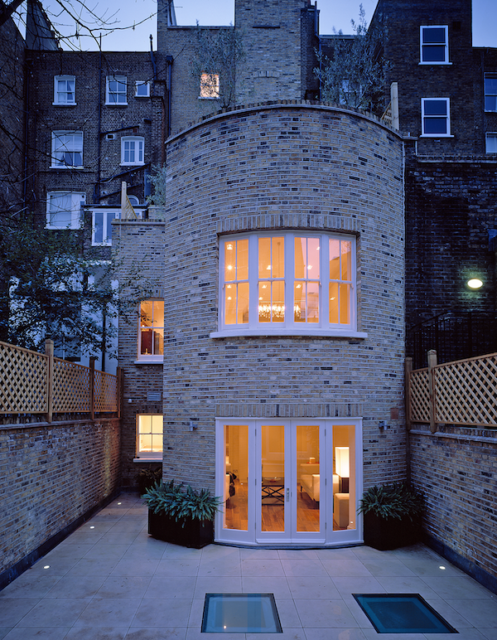
BB Partnership have extensive experience working on the Cadogan Estate. Read more about the refurbishment and extension project we completed for a Grade 2 listed building in Chelsea. The project included refurbishment and extension of Grade 2 listed building in the heart of Knightsbridge for the top-end residential market.
The approval process requires an application to be made that includes detailed information on the project that has been prepared by the design team. Depending on the scope of the project the design team may include Architect, Structural Engineer, Building Services Engineer, Acoustic Engineer, Building Surveyor and potentially other specialist consultants.
Cadogan, have very specific requirements as to how the works are designed and carried out including which types of materials can be used. It is essential that the design team understand these requirements from the outset to ensure that the scheme is designed to meet the requirements of the estate.
A good example of these requirements is the process that Cadogan will apply to any request to change the flooring of a flat from carpet to timber or other types of hard floor, which requires an acoustic test to be carried out of the existing condition [i.e. with a carpet in place] to establish a bench mark that any proposed hard floor finish will need to meet, which would also need to be tested in situ. This can lead to a situation that Cadogan require a higher level of acoustic performance then the minimum level stipulated in the Building regulations. It is very important to understand that the estate do not negotiate to alter their detailed requirements, so it is best to work to these from the outset.
Depending on the scope of the works, the Estate may require a third-party Structural Engineer, Building Services Engineer, Acoustic Engineer or other specialist to provide an independent review of the proposals. This will be assessed on an individual basis and any reasonably incurred fees will be re-chargeable to the applicant.
In addition the estate is located within The Royal Borough of Kensington and Chelsea from who it will also be necessary, where relevant, to obtain planning approval.
Given the heritage of the area, most properties a located within Conservation Areas, that impose tighter planning restrictions over and above. A significant proportion of the properties are also Listed, for which Listed Building Consent will be required. Whilst it may seem that approaching the estate is something to do after planning approval or listed building have been obtained it is best to be aware of their requirements prior to making the applications as the requirements may require amendments to the design prepared for planning.
As noted above the way in which the works are carried out is also controlled by the estate and the approval is linked to their satisfactory completion on site.
BB Partnership have extensive experience of undertaking projects within the estate, ranging from flat refurbishments to whole house refurbishments that have included large basement developments. We would always advocate early engagement with the Cadogan Estate, if you would like us to help with your project then please don’t hesitate to get in touch.
Private House, Chelsea, London SW1
Heritage, Private Residential
New-build House, Knightsbridge, London SW7
Private Residential
Private House, Knightsbridge, London SW7
Private Residential
Refurbishment and Extension of Existing House, Chelsea, London SW3
Heritage, Private Residential

Can air conditioning be installed in a listed building in Camden? In many cases it can but planning permission and listed building consent are usually required, and applicants must demonstrate that passive design measures have been explored before comfort cooling is approved.
Many homeowners in central London are beginning to ask this question.
Hotter summers, increasingly airtight homes and the urban heat island effect mean that overheating is becoming an increasing concern [ … ]
Our gender pay gap data and our approach to transparency, equality and employee ownership
BB Partnership publishes its gender pay gap data voluntarily as part of our commitment to transparency and fair pay.
As an employee-owned architectural practice, we believe that clear and equitable pay structures are essential to building a collaborative and sustainable workplace. Salaries across the practice are determined by role, experience and responsibility, and employees undertakin[ … ]
Advice from BB Partnership based on experience delivering projects across Grade I, Grade II* and Grade II listed buildings.
Developing a listed building can be hugely rewarding, but it comes with a level of scrutiny and complexity very different from working with unlisted stock. Whether the project involves refurbishment, conversion or extension, understanding how listed building rules affect design, planning an[ … ]
Successful residential projects depend on a strong and well-structured relationship between architect and interior designer. When collaboration is established early and roles are clearly understood, the result is not only a compliant and well-coordinated building, but an interior that is delivered exactly as envisioned.
At its best, this relationship is complementary. The interior designer shapes the spatial experience, material language and character of the home. The architect ensur[ … ]
The Grosvenor Estate is one of London’s most significant historic landholdings, with ownership in Belgravia and Mayfair dating back to the early 18th century. These areas were developed as coherent townscapes, with carefully planned townhouses, mews streets and formal squares.
This long-term stewardship has resulted in areas of exceptional architectural quality, much of which is now protected through listing, conservation area designation and Estate Management Schemes. Grosvenor’[ … ]
The Building Safety Act 2022 (BSA) introduced a new duty-holder regime that fundamentally changes how building projects are designed and delivered in England. Central to this regime is the Principal Designer (Building Regulations) (PD-BR): the person or organisation responsible for planning, managing and coordinating compliance with the Building Regulations during the design phase.
Despite being a mandatory role on almost all projects requiring Building Control approval, the PD-BR is[ … ]