

The Building Safety Act 2022 (BSA) introduced a new duty-holder regime that fundamentally changes how building projects are designed and delivered in England. Central to this regime is the Principal Designer (Building Regulations) (PD-BR): the person or organisation responsible for planning, managing and coordinating compliance with the Building Regulations during the design phase.
Despite being a mandatory role on almost all projects requiring Building Control approval, the PD-BR is still widely misunderstood. Clients are often unclear who should take on the role, what it involves, or what happens if no one is appointed.
This article provides a practical overview, based on our experience acting as Principal Designer across residential, heritage, co-living, PBSA and mixed-use projects.
The PD-BR is appointed by the client to:
This is a statutory role that applies to all projects requiring Building Control approval, not just Higher-Risk Buildings (HRBs).
A frequent misunderstanding is that the PD-BR role only applies to Higher-Risk Buildings (HRBs), where applications are reviewed by the Building Safety Regulator (BSR).
This is incorrect.
The duty to appoint a PD-BR applies to all building work under the Building Regulations, including:
HRBs introduce additional Gateway approvals, but the Principal Designer requirement is universal.
That said, while the role applies to all projects, HRBs differ in how and when compliance information must be provided.
For HRBs, applications to the BSR require a much higher level of design resolution and compliance evidence at application stage, particularly at Gateway 2.
On non-HRB projects, some technical detail may be developed progressively as the project moves on site. For HRBs, however, the expectation is that the design, including key fire, structural and building services strategies, is substantially resolved before construction begins.
This does not change the role of the Principal Designer, but it does significantly increase the scope, coordination and front-loading of work required.
To illustrate how this plays out in practice, the key differences between HRB and non-HRB projects are summarised below.
While the Principal Designer (Building Regulations) role applies to all projects requiring Building Control approval, the timing, level of detail, and regulatory process differ significantly between HRB and non-HRB schemes.
The PD-BR must be able to demonstrate:
The role is commonly undertaken by architects, technologists, engineers or specialist compliance consultants, but only where competence can be clearly evidenced.
Although the titles are identical, the PD-BR role is not the same as the Principal Designer under CDM 2015.
A practice may undertake both roles, but they are separate statutory appointments.
The Building Safety Act makes an important distinction between domestic and commercial clients.
If no PD-BR is appointed, the designer in control of the design phase automatically becomes the Principal Designer.
In practice, this is often the architect, even where their scope of service is limited, which can lead to confusion and unintended risk.
If a commercial client fails to appoint a PD-BR, the client themselves becomes responsible for fulfilling the Principal Designer duties.
The role does not automatically transfer to a designer.
When a Building Control application is submitted, the PD-BR must be formally named. Once appointed, the Principal Contractor must also be declared (and at Gateway stage for HRBs).
If the PD-BR changes during the project, a formal notification of change must be made.
Failure to do so can result in:
This requirement is frequently overlooked on domestic and smaller residential projects.
Clients often ask whether an architect can be appointed only to secure planning or submit an initial Building Regulations application, with the contractor taking over thereafter.
A contractor can act as PD-BR, but only if they are competent and formally appointed. This requires:
In practice, many small and medium-sized contractors are not set up to do this.
Where no competent replacement is appointed, responsibility reverts to the client (or the architect by default on domestic projects). If the architect is no longer involved during construction, this creates a clear compliance risk unless a replacement PD-BR is identified.
A common risk arises where architects are engaged only for:
Clients may assume the architect remains the PD-BR. However, if the architect is not:
…then they are not performing the Principal Designer role.
This creates a dangerous gap where responsibility is assumed but not discharged, precisely the situation the Building Safety Act seeks to prevent.
Specialist consultants and installers (M&E, drainage, fire systems, acoustics, etc.) are legally classed as designers under the Act. They are responsible for the compliance of their own design work, but not for coordinating the wider design.
That responsibility always sits with the PD-BR.
Where no dedicated MEP designer is appointed and design is carried out by subcontractors, the need for a competent PD-BR becomes even more critical.
For projects requiring an application to the Building Safety Regulator, key building services design, including MEP, fire systems and life-safety strategies, must be fully developed and coordinated at application stage. These elements cannot be deferred to contractor or subcontractor design later in the process, as has historically occurred on some non-HRB projects.
The PD-BR role cannot be fulfilled without:
Architects should only accept the PD-BR role when they are formally appointed and when the scope clearly sets out what is required. Equally, architects must explain to clients what is needed to comply with the legislation, including:
“Light-touch” involvement is not compatible with the statutory role.
The PD-BR role applies to many projects that previously proceeded without architectural involvement — for example internal refurbishments led by interior designers or directly by contractors.
Under the Building Safety Act, these projects still require a competent Principal Designer (Building Regulations).
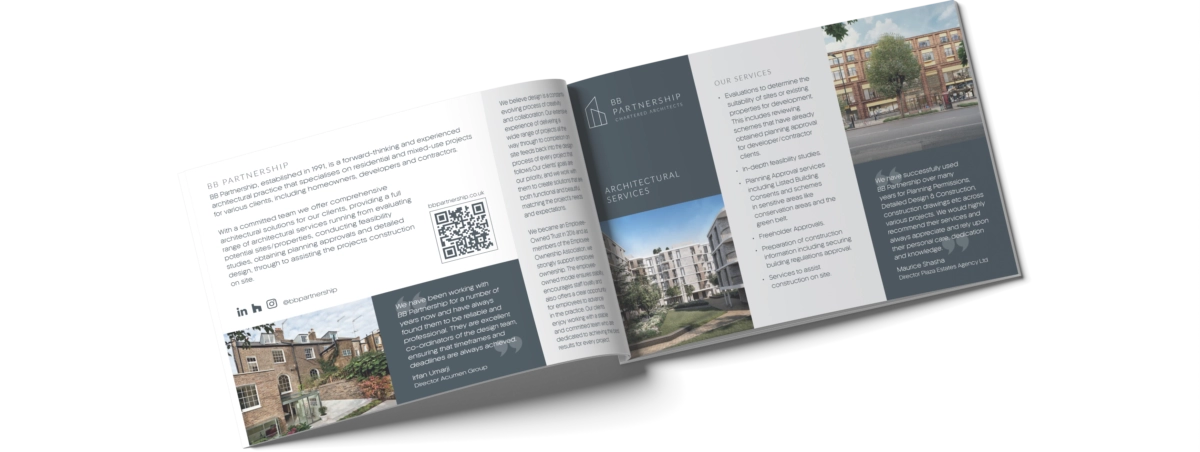
BB Partnership regularly acts as Principal Designer (Building Regulations) as part of our role as Architect and as Executive Architect, across residential, heritage, co-living, PBSA and mixed-use projects.
We provide:
If you’d like support understanding your obligations under the Building Safety Act, or appointing the right Principal Designer, we’d be very happy to help.

BA (Hons), Dip Arch, RIBA
Director

BA (Hons), Dip Arch, RIBA
Director

BA (Hons), Dip Arch, RIBA
Director