Open Plan Living and Fire Safety: Fire Doors vs Fire Curtains
Open Plan Living and Fire Safety: Fire Doors vs Fire Curtains
Open Plan Living and Fire Safety: Fire Doors vs Fire Curtains
In the residential sector, clients often ask us to create large open-plan spaces. While this achieves a bright and contemporary feel, it must always be balanced against fire safety requirements set out in Building Regulations.
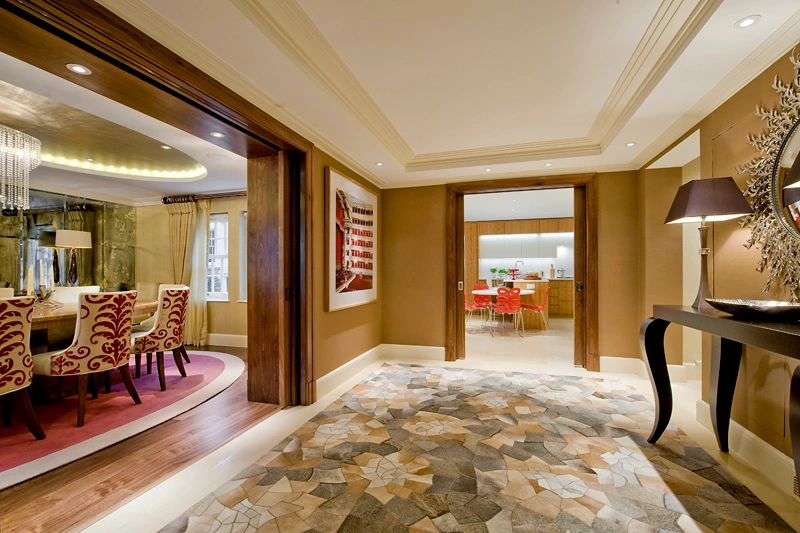
(Featured Image) One of our projects in Holland Park – the fire curtain is detailed into the timber lining around the openings.
Fire Escape and Protected Routes
For houses with only a ground and first floor, it is usually acceptable for the staircase to be open to the main living space. However, once a property extends over three or more floors, the staircase must form part of a protected route.
A protected route is a sterile, fire-resisting zone that provides a safe escape path out of the property.
To achieve this:
Rooms accessed from the stair and hall are generally separated by fire doors.
These are normally specified to provide 30 minutes of fire resistance.
Fire Doors: Integrity, Radiation and Insulation
Fire doors are classified under the same European standard (EN 13501-2) used for fire curtains:
E (Integrity): Prevents passage of flames and smoke, but allows heat transfer.
EW (Integrity + Radiation Control): As well as integrity, limits radiant heat to 15 kW/m² at 1 m from the surface. Sometimes used for glazed fire doors.
EI (Integrity + Insulation): Prevents flames and smoke and also limits the temperature rise on the unexposed face (≤140°C average, ≤180°C max).
In practice:
A standard FD30 timber fire door is usually tested to EI30, so it not only holds back fire and smoke but also controls heat transfer.
Glazed or metal fire doors are more variable:
Many achieve E30 (integrity only) or sometimes EW30, meaning they stop flames but allow radiant heat through.
Some specialist glazed systems (multi-layer fire glass or gel-filled glazing) can achieve EI30 or EI60, but they are heavier, thicker and more expensive.
Timber glazed doors generally perform better than metal glazed doors, as the timber frame provides better insulation against heat. Metal framing, by contrast, is highly conductive and often prevents the door from meeting the insulation criteria, even if it achieves integrity.
Note: In dwellings, Building Regulations typically require FD30 doors (integrity only) for protected routes. Insulation is not specifically mandated but may be requested by Building Control, fire engineers or insurers depending on risk.
It is also worth noting that while comparisons with doors are useful, fire curtains are usually deployed across much larger openings. They are therefore more directly comparable to a solid or glazed wall system than to a single door. Any wall or glazed screen forming part of a protected route must perform to the required fire rating, so the curtain should be judged against this same expectation.
What is a Fire Curtain?
A fire curtain is a retractable, heat-resistant fabric barrier housed within a roller box. It automatically deploys when the fire alarm is triggered, containing smoke and fire, maintaining escape routes, and allowing compliance with fire regulations, without compromising open-plan design.
Key Design and Coordination Requirements
Early Integration: The roller box must be designed in at an early stage as part of the coordinated design process.
Wall Guides: Curtains run within side guides, ideally recessed into the wall to reduce visual impact.
Sensor Beam: A safety beam prevents the curtain from fully deploying if obstructed, triggering an audible warning if blocked for more than a short period.
Control Systems: Require:
Connection to the fire alarm system
A control panel and manual override button to allow the curtain to be raised
Battery backup or safety fail-safe
Large Openings: Curtains can cover much wider spans than fire doors, making them suitable where generous openings are essential.
(Above) One of our schemes in Knightsbridge showing a wide opening between the Dining Room and Hall – the fire curtain is detailed into the timber lining around the openings.
Fire Curtain Ratings: Integrity, Radiation and Insulation
Like fire doors, fire curtains are tested under EN 13501-2:
E (Integrity): Prevents flames and smoke passing through, but heat still radiates.
EW (Integrity + Radiation Control): Limits radiant heat to ≤15 kW/m² at 1 m distance, enough to prevent ignition of common items like fabrics or paper during the rated period.
EI (Integrity + Insulation): Keeps the safe-side surface temperature rise to ≤140°C average / ≤180°C max, offering full insulation and protecting people close to the curtain.
In residential settings, most fire curtains are E or EW rated, which is usually sufficient for Building Control. EI-rated curtains (e.g. Coopers Insul8 EI90 or SuperPlus EI120) are available but bulkier, more expensive, and mainly used in commercial or high-risk projects.
It should also be remembered that the Building Regulations set a minimum standard for fire safety. While E-rated products may technically comply, specifying EW or EI performance where feasible can provide more robust protection, especially for escape routes or areas where people may need to pass close to the curtain during evacuation.
Advantages of Fire Curtains
Preserve Open Plan Layouts – Allow compliance without permanent walls or doors.
Discreet Design – Hidden in a ceiling roller box; guides recessed for minimal visibility.
Automatic Operation – Deploys on alarm signal without manual input.
Flexible Protection – Suitable for stairs, lobbies, or compartment lines.
Cost-Effective – Cheaper than a fire rated glazed wall
In the event of an alarm they will close, open doors won’t.
Wide Spans – Can protect larger openings than fire doors.
Limitations of Fire Curtains
Maintenance Requirements – Require regular servicing and testing.
Fire Resistance Duration – Rated 30–120 minutes, but not as easily robust as walls with doors
No Acoustic Barrier – Don’t block sound or provide physical security.
Not Always an Alternative to Doors – Building Control may still require fire doors.
Should form part of an overall fire engineering solution developed with a fire engineer that may also require a more sophisticated fire detection and alarm system than if doors and walls were used.
Compliance and Safety Features
Total Gravity Fail Safe (TGFS): Ensures the curtain will deploy by gravity even if mains power fails, a key safety feature required under BS 8524.
Certification: All fire doors and curtains must be third-party accredited to standards such as BS 8524 and EN 1634-1, demonstrating tested and proven performance.
Smoke Control Options: Some curtains include smoke seals to prevent smoke spread as well as fire.
Monitoring & Maintenance: Systems like Coopers Connect allow remote monitoring, providing alerts and diagnostics to ensure long-term reliability.
Typical Applications
Open-plan kitchens in houses especially in lower ground floor locations where the main stair opens onto the kitchen.
Providing living spaces that open up onto the hallway
In conjunction with non-fire rated glazed screens and doors
To improve the flow though a space without the need to open and close a door.
DOWNLOAD THE BB PARTNERSHIP BROCHURE
BB Partnership’s Experience
At BB Partnership, we have worked with both owner-occupiers and developers to integrate fire curtains into residential schemes. This has meant achieving the open-plan layouts they wanted while still complying with Building Regulations. For developers, fire curtains have been particularly useful in multi-unit housing schemes, where balancing design ambition with fire safety and Building Control approval is essential.
Our experience shows that successful use of fire curtains depends on early coordination between architect, fire engineer, and supplier, ensuring the roller box, guides, and control systems are seamlessly integrated into the overall design and obtaining approval from Building Control at an early stage.
Important Note
This article provides general advice only on the topics at the time of writing. Fire safety requirements are project-specific, and all fire doors and curtains must be supplied with valid third-party certification confirming their tested performance. Always consult with Building Control and a qualified fire engineer when specifying products.