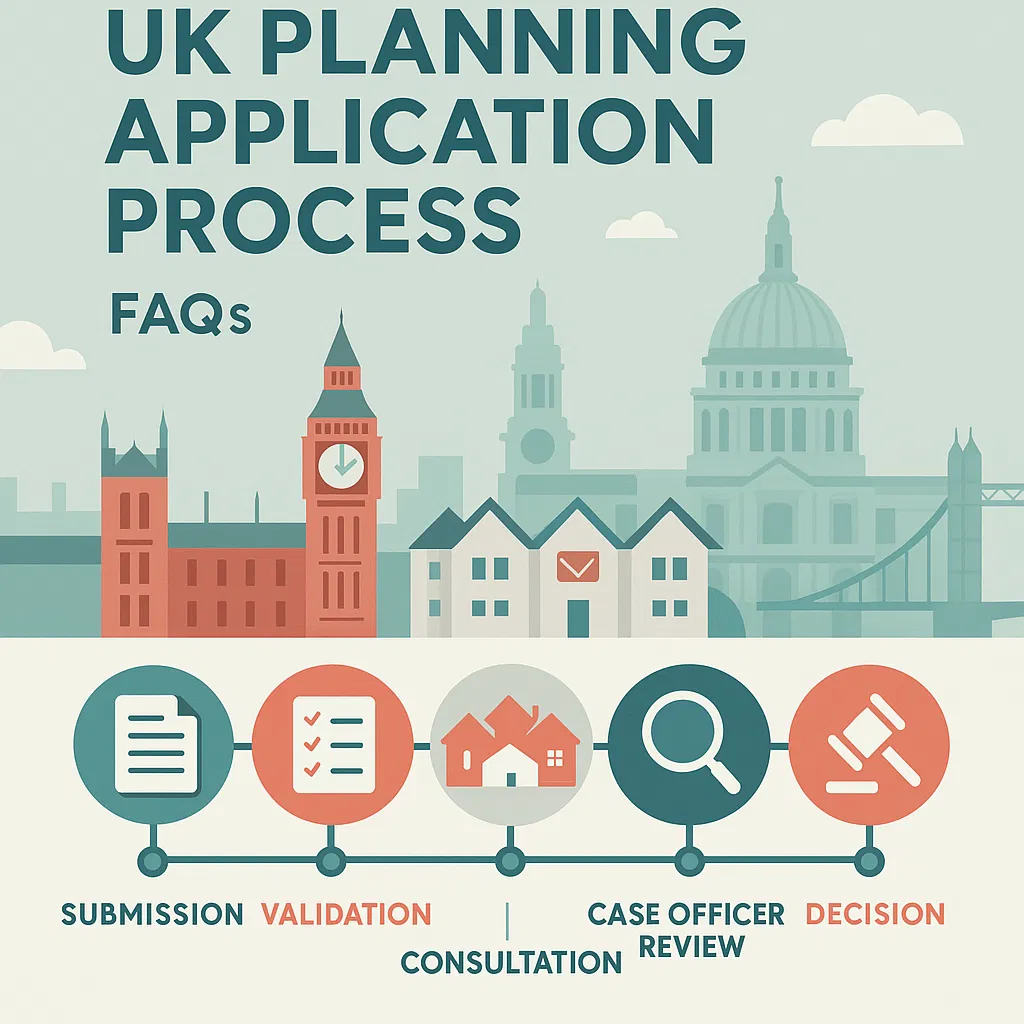
Frequently Asked Questions About the Planning Process
Frequently Asked Questions About the Planning Process
Frequently Asked Questions About the Planning Process
Following on from our article “How Long Do Planning Applications Really Take?” we have put together a Q&A on some of the most common questions clients have about what happens after a planning application has been made.
On the projects we are involved with, we or the planning consultant carry out the role of agent on behalf of the applicant, but the questions are equally appropriate if you have submitted an application yourself.
What happens if the application has gone over the 8-week target?
If an application has gone beyond 8 weeks without a decision, then there are a few options:
Check for an Extension of Time Agreement In many cases, the local authority will ask you to agree to an extension, especially if they need more time to consult on the proposal or finalise a report. If you’ve already signed one, then the new target date becomes the formal benchmark for decision-making.
Contact the Case Officer If no extension has been agreed, the first step is to contact the planning officer handling your application. Politely ask for an update, and whether they anticipate a decision soon. Be aware that case officers are often handling large caseloads and may be waiting for internal or external consultee comments.
Submit a Non-Determination Appeal If no decision has been made within 8 weeks (or the agreed extended time), you have the legal right to appeal to the Planning Inspectorate for non-determination. However, this route can be lengthy, often taking several months, and may be best used in cases where there’s been little engagement or clear delay.
Keep the Relationship Constructive In most cases, it’s better to maintain a cooperative relationship with the planning authority. Sometimes a short delay can lead to a negotiated solution that avoids a refusal and a costly appeal.
Part of the role of an Architect or Planning Consultant is to act as the agent on behalf of the applicant, and as part of that to monitor the application and follow up the suggested actions above when necessary.
What do I do if I can’t get through to the case officer?
It’s not uncommon for case officers to be hard to reach, many are juggling high caseloads and limited admin support. If you’ve tried calling or emailing without a response, here’s what you can do:
Send a Polite, Concise Follow-Up Email Keep it brief, include the application reference, site address, and your specific query. Mark it as a follow-up if you’ve already made contact before.
Copy in the Team Leader or Duty Planner Most planning departments have a team structure. If the officer isn’t responding after several attempts, look up the team leader’s details on the council website and copy them into your email. Some councils also publish a duty planner contact for general queries.
Increasingly, planning departments are restricting the contact details for case officers to a generic planning email address.
Request a Call-Back Through the Council’s Switchboard If you’re hitting a wall via email, call the main planning switchboard and request a message be passed on, or ask for an alternative contact.
Remain Professional and Constructive Frustration is understandable, but keeping the tone of your communication professional can often help encourage engagement.
Do officers have to get in touch with the applicant about what could change to make an application acceptable, or can they just make a decision?
Planning officers are encouraged, but not legally required, to engage with applicants if they believe an application could be made acceptable through changes. The National Planning Policy Framework (NPPF) states that local authorities should “look for solutions rather than problems” and work positively with applicants wherever possible.
However, there are a few key things to bear in mind:
Discretionary Engagement Whether or not the officer contacts you or, where applicable your agent, during the application is at their discretion. If they think the issues are too fundamental, or if time pressures are high, they may proceed directly to a refusal.
Minor Changes Are More Likely Officers are more inclined to engage when the required changes are modest and capable of being resolved within the statutory timeframe (e.g. small design tweaks or clarifications on materials). For more substantial issues (e.g. massing, scale, land use), they may opt for a straight refusal.
Prepare well A well-prepared application that anticipates likely concerns, and includes a planning statement or design rationale, can reduce the risk of refusal and make it easier for the officer to support or negotiate on your behalf.
Engaging Proactively Helps We always recommend reaching out to the officer early, and offering to respond to feedback if it arises.
In short: officers can refuse without discussion, but giving them reasons to talk to you, and having a team ready to act quickly if needed, can often change the outcome.
What do I do if neighbours object?
Neighbour objections are common, and not necessarily fatal to a planning application. The key is understanding how they’re handled and how to respond constructively:
Understand What Counts Planning officers are only allowed to consider material planning considerations, such as loss of light, overlooking, noise, design, traffic or impact on character. Objections based on personal dislike, property values, or construction disruption are not material and will be given little or no weight.
Review the Objection Carefully If you receive notice of an objection, ask to see the details or check the council’s planning portal. Understanding the nature of the concern is essential, sometimes it can be resolved with a simple clarification or minor change.
Provide a Clear, Reasoned Response If the issue raised is valid and you’re still within the consultation period, it’s possible to submit additional information or a covering letter to address it. This shows the officer that you’re engaging positively and can help defuse opposition.
Let the Design Speak A well-considered design, particularly one that’s supported by daylight/sunlight studies, overlooking diagrams, or contextual analysis, can often override neighbour objections. Planning is not a popularity contest; it’s a policy-based decision.
Speak to the Officer You (or your architect/planning consultant) can contact the officer to discuss how the objections are being interpreted and whether a response or amendment is advised.
Stay Constructive While it can be upsetting to receive objections, especially from immediate neighbours, responding calmly and constructively can make a difference. Hostile exchanges rarely help, and officers are used to managing a balance of views.
If an application will also be sent to the parish council, should my architect attend?
If your site falls within a parish council area, the council will be formally consulted as part of the planning process. While their comments are not binding, they do form part of the public consultation and can influence the case officer’s view, especially in smaller or rural authorities.
Whether your architect should attend the parish council meeting depends on a few factors:
Is the Application Likely to Be Controversial? If the scheme is likely to raise local concerns, on matters like scale, access, or design, then having your architect attend can be beneficial. It shows transparency, allows you to explain the design rationale, and can help address misunderstandings early.
Does the Parish Council Allow Applicant Presentations? Some parish councils invite applicants or their agents to speak; others do not. Check the council’s policy or agenda in advance. If presentations are allowed, your architect can prepare a short, clear explanation of the proposal.
Can the Architect Help Defuse Objections? A skilled architect can often reframe objections by highlighting how the design has responded to local context or planning guidance. This is particularly valuable if the application is finely balanced or there’s a history of refusal on the site.
Local Representation Can Help Build Support In more rural or sensitive areas (like parts of Epping Forest), building trust with the parish council can help secure a positive recommendation, or at least avoid a recommendation to refuse.
Do planning officers have to accept revised drawings as part of a negotiation?
No—planning officers are not obliged to accept revised drawings during the course of an application, even if they invite or receive them. Whether they do so is at their discretion and often depends on timing, complexity, and internal policy.
Here’s what you should know:
Officers Can Accept Revisions, But Aren’t Required To Some authorities welcome revisions to resolve issues and avoid refusal. Others discourage changes during live applications and prefer withdrawal and resubmission. It varies widely between councils, and sometimes between officers.
Timing Is Critical If you offer revised drawings too late in the process (e.g. just before the decision deadline), the officer may decline them due to time constraints or because they would trigger a need for re-consultation with neighbours or consultees.
Minor Tweaks Are More Acceptable Officers are more likely to accept small, clear revisions that address a specific issue, like moving a window or adjusting a roofline, especially if they don’t materially change the scheme or its impact.
Formal Revisions May Extend the Deadline In some cases, the officer may agree to take revisions if you also agree to an Extension of Time. This gives them breathing room to re-assess the changes properly and consult if needed.
It Helps to Be Proactive and Cooperative The chances of an officer accepting revisions increase when the applicant (or their architect) engages early, responds promptly, and provides well-presented, clearly explained drawings.
If an application is not in alignment with policy, can the officer approve it or are they required to refuse it?
Planning policy is the foundation for decision-making, but officers are not strictly required to refuse applications that depart from policy. In fact, planning law allows for flexibility and professional judgement, particularly where material considerations indicate a departure may be justified.
Here’s how it works in practice:
Policy is the Starting Point, Not the End Section 38(6) of the Planning and Compulsory Purchase Act 2004 states that decisions must be made in accordance with the development plan unless material considerations indicate otherwise. So officers start with policy, but they’re not bound by it in every case.
Material Considerations Can Override Policy If there are strong site-specific reasons, public benefits, or mitigating factors (such as heritage gain, housing delivery, or exceptional design quality), officers can recommend approval, even where there’s a policy conflict.
Policy is Interpreted in Context Many policies are not black-and-white. Officers often have to weigh competing priorities, such as heritage versus sustainability, or design standards versus site constraints, and make a balanced judgement.
It Depends on the Degree of Conflict A minor departure from policy may be accepted if the proposal broadly aligns with the council’s objectives. A major conflict, like building in protected Green Belt or failing minimum space standards, is much harder to overcome.
The Officer’s Recommendation Isn’t Final If the officer supports a departure from policy, the decision may need to go to planning committee for approval. In some cases, senior officers or legal teams will also be consulted before a recommendation is finalised.
In short, officers can approve out-of-policy schemes, but they must clearly justify why, and normally they will recommend an application for approval but it will have to then be approved at planning committee, but it should be noted that given the current time pressures on planning officers they are more likely to fall back on policy and reject a non-compliant scheme.
If the officer advises that they are of a mind to reject an application and suggest it is withdrawn, what are the benefits of this compared to letting it be rejected, and is a rejection ever more useful than withdrawing?
It’s quite common for planning officers to suggest withdrawing an application when they’re minded to refuse it. This gives the applicant a chance to revise and resubmit, avoiding a formal refusal on the public record. But whether to withdraw or proceed to a decision depends on the context, and your wider strategy.
Benefits of Withdrawing an Application
Avoids a Refusal on Record A formal refusal becomes part of the site’s planning history and must be addressed in future applications. Withdrawing avoids this and keeps the slate cleaner, but the withdrawn application is still part of the public record, so it is relatively easy to see that an application was made for something that was not approved.
Easier Path to Revised Submission If you withdraw proactively, the officer is often more open to engaging on a revised proposal. It signals cooperation and can reset the relationship more positively. Sometimes this can be used as a bargaining tool, as otherwise the officer has to write up the rejection, so it saves them time if the application is withdrawn.
When Letting It Be Refused Might Be Better
You Disagree with the Officer’s Reasoning If you strongly believe the officer has misapplied policy or misunderstood the scheme, a refusal gives you something tangible to appeal, and could ultimately result in approval by the Planning Inspectorate.
You Want to Establish a Formal Position In some complex or contentious cases, a refusal can help clarify the authority’s position and reasoning, which may be useful for appeal, future applications, or even public inquiries.
Do the officers have to make a site visit?
No—planning officers are not legally required to carry out a site visit in every case. However, in practice, most officers do visit the site before making a recommendation, especially for householder or smaller residential applications where the impact on neighbours or context needs to be understood on the ground.
Here’s how it typically works:
When Site Visits Are Common
Householder Extensions or Alterations Officers will often visit to assess privacy, overlooking, daylight impacts, and general fit within the street scene.
Applications in Conservation Areas or Near Listed Buildings Understanding the site’s character and setting is usually essential, so site visits are the norm.
Schemes with Objections If there are neighbour concerns, officers often visit to judge the relationship between properties and to view any contested issues firsthand.
New Builds or Sensitive Sites Larger or more complex proposals generally trigger a visit, even if it’s just to view from the street.
When They Might Not Visit
Very Minor Proposals Some straightforward applications, like signage or certificate of lawfulness cases, may be determined using aerial images, photographs, or street view.
During Time Constraints or Resource Issues Occasionally, due to heavy caseloads or access restrictions, an officer may rely on online imagery, submitted photos, or past visit records.
Can You Request a Visit?
While you can’t require a site visit, it’s reasonable to ask, especially if there are specific aspects of the site that aren’t obvious from plans or photos. You can also offer to provide up-to-date photos or grant easy access if that helps facilitate a visit.
What happens if the decision goes to committee?
Most applications are decided by planning officers. However, if the application is controversial or contrary to policy, it may go to planning committee. This can delay the process and may involve a public meeting at which the applicant or the applicants team have the right to speak as do objectors to the scheme.
If my application is refused, can I reapply?
Yes. You can submit a revised application, often free if done within 12-months of the original refusal. Alternatively, you can appeal to the Planning Inspectorate, but it should be noted that the Planning Inspectorate’s role is to asses if the local authority made the correct decision inline with their policy and as such most appeals are dismissed, so the first and quickest step following a rejection is to see how the reasons for rejection could be overcome with a revised scheme.
Can I make changes after permission is granted?
Yes. Minor changes may be made through a non-material amendment. More significant alterations might require a minor material amendment or a new application.
DOWNLOAD THE BB PARTNERSHIP BROCHURE
Conclusion
A successful planning outcome starts well before submission. In today’s planning environment, where engagement is limited and resources are stretched, the best way to ensure progress is to submit a well-prepared, policy-aligned, and professionally justified application.
That means involving the right team early: from your architect and planning consultant to any technical specialists required to support the case. Investing time in the pre-application process, where available, can significantly reduce risk and improve your chances of approval.
Let’s Talk
At BB Partnership, we specialise in unlocking planning potential through clear strategy, policy expertise, and carefully crafted design. If you’re planning a project and want to give it the best possible start, we’d be happy to help, get in touch.