

Balancing Policy, Heritage, and Compliance in a Restrictive Landscape
(Updated: May 2025)
In the high-value, policy-sensitive boroughs of Westminster, the Royal Borough of Kensington and Chelsea (RBKC), and Camden, the amalgamation of residential units, the combining of two or more dwellings into one — is a subject of tight control. While the default position in all three boroughs is to resist the net loss of homes, recent shifts in planning tone, heritage-led design considerations, and a growing focus on family housing have opened up narrow but notable opportunities.
These local policies are framed within the wider context of the London Plan (2021), in particular Policy H1 (Increasing Housing Supply), which requires boroughs to optimise housing delivery. Boroughs are therefore cautious about losing residential units through amalgamation unless compelling public benefits — such as the creation of family housing or the restoration of a heritage asset, are clearly demonstrated.
Westminster City Council maintains a firm presumption against amalgamations under Policy 8 of the Westminster City Plan 2019–2040, which states that “the net loss of residential units will not be permitted.” However, there are limited exceptions, particularly when the resulting unit contributes positively to housing need.
The supporting text (para. 8.13) specifically notes:
“The loss of residential units through amalgamation will generally be resisted, unless it can be demonstrated that the proposed amalgamation would create a family-sized unit where there is a demonstrable shortage of such accommodation in the area.”
The policy also imposes a maximum size threshold of 200 square metres (GIA) for dwellings created via amalgamation, to discourage the creation of super-prime units that do not meet broader housing needs.
RBKC’s policy position is set out in the 2024 Local Plan, under Policy HO1 (Housing Growth), which confirms that the net loss of homes, including through amalgamation, will generally be resisted. However, a 2024 clarification note and supporting text indicate that exceptions may be allowed where:
This flexible interpretation allows for planning judgment where the loss of units results in a qualitative gain aligned with housing needs or heritage conservation goals.
Camden’s Local Plan Policy H6 (Housing Choice) discourages the loss of self-contained homes through amalgamation. However, it provides flexibility where the proposal:
Proposals that demonstrate the creation of homes aligned with Camden’s minimum space standards, especially from substandard units, may receive favourable consideration.
All three boroughs offer conditional support for amalgamations that result in larger homes suitable for families, often a 3-bedroom dwelling of at least 86 sqm GIA under national standards. This support is strongest where:
Where subdivision has harmed the architectural integrity or significance of a listed building, planning authorities may support amalgamation to reinstate the original layout or plan form. This aligns with the National Planning Policy Framework (NPPF) objective of conserving and enhancing designated heritage assets.
Where two or more units fail to meet current minimum standards — for instance, in terms of floor area, layout, natural light or amenity, their amalgamation into a single, compliant home may be presented as a net qualitative gain, not simply a reduction in quantity.

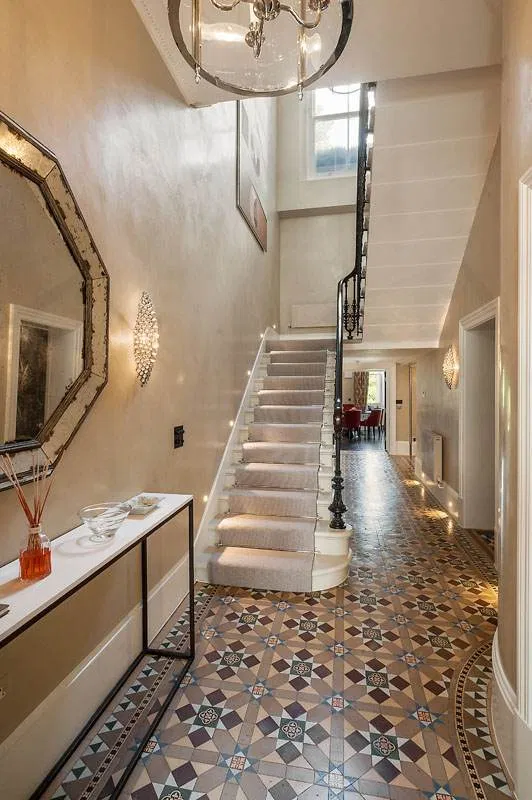
Once upon a time it was relatively simple to amalgamate flats. For this project, a Grade II Listed building in RBKC, we also infilled the lightwell with a frameless glass extension working with Turner Pocock interior design studio
Amalgamating homes also has regulatory consequences. Under Building Regulations 2010, combining two flats into one constitutes a material change of use under Regulation 5. This triggers full compliance with relevant parts of the regulations, as if the resulting unit were a new dwelling.
In particular, Approved Document L (Conservation of Fuel and Power) may require:
Example: Even if the physical work appears minor, such as removing a dividing wall, building control may require costly retrofits across the entire enlarged flat to bring it up to current energy performance standards.
This can present significant challenges, especially in listed buildings, where modern insulation and services must be reconciled with conservation requirements.
Amalgamation involving a listed building will require listed building consent, even if the works are internal or minor. Proposals that restore historic layouts may be supported, but those that combine units which were historically separate — such as a pair of original mews houses, may face resistance. Each case depends on the building’s historic form and significance.
Where properties are leasehold, freeholder approval will be required. In prime London estates such as Grosvenor, Cadogan, or Eyre, estate management schemes may:
These factors can materially affect the viability of a scheme and should be investigated prior to design development.
Where a team identifies potential for amalgamation, it is often advisable to submit an initial application to establish the principle, before progressing with extensive design, extensions, or fit-out proposals. Securing early planning clarity can prevent abortive costs and reduce risk if the local authority is unlikely to support the amalgamation in principle.
Amalgamating homes in Westminster, RBKC, and Camden is rarely straightforward. However, boroughs have demonstrated in-principle support where proposals:
Successful applications are those supported by a clear planning strategy, evidence of local need, careful design, and early consideration of building control and leasehold issues. In the right circumstances, amalgamation can be both a viable planning outcome and a meaningful contribution to London’s evolving housing stock.
This article was prepared in May 2025. Planning policies, particularly in RBKC, are actively evolving. While the guidance here reflects current policy, it is essential to consult the most recent versions of borough Local Plans, estate-specific regulations, and relevant appeal decisions along with obtaining specific advice from a suitably qualified expert before preparing or submitting an application.
Westminster City Plan 2019–2040: Policy 8 – Housing for Inclusive Communities
RBKC Local Plan 2024: Policy HO1 – Housing Growth
RBKC Planning Clarification Note (2024) – Available via RBKC Planning Policy team
Camden Local Plan 2017: Policy H6 – Housing Choice
London Plan (2021): Policy H1 – Increasing Housing Supply
Technical Housing Standards – Nationally Described Space Standard (2015)
National Planning Policy Framework (NPPF) – Heritage and Design Section
Building Regulations 2010: Regulation 5 – Material Change of Use
Approved Document L (2021 Edition): Conservation of Fuel and Power

BA [Hons], Dip Arc, RIBA
Director

BA [Hons], Dip Arc, RIBA
Director

BA [Hons], Dip Arch, RIBA
Director