
At BB Partnership, we believe the future of urban living means working smarter with the built environment we already have. While Co-Living and Purpose-Built Student Accommodation (PBSA) schemes are typically viewed as new-build opportunities, the adaptive reuse of existing buildings offers substantial environmental, economic, and urban design benefits, especially for developers navigating increasingly complex planning and delivery constraints.
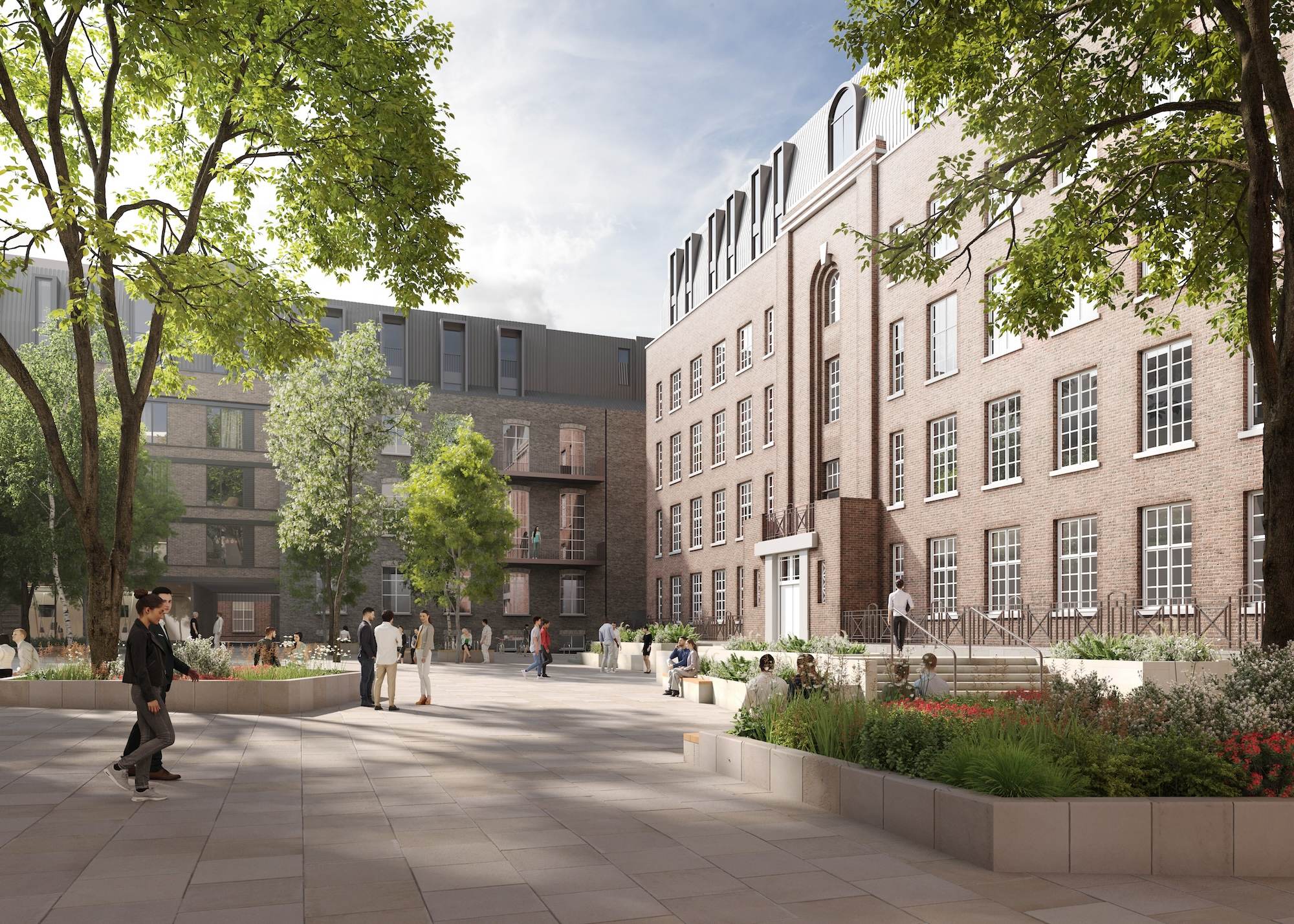
Our Woolwich Island project, situated in the Bathway Quarter Conservation Area, repurposes several Grade II and locally listed buildings to deliver 485 Co-Living units, 20 affordable homes, and an inviting public realm. It follows on from our consent at Cricklewood Broadway scheme, to convert deep-plan commercial buildings into purpose-designed Co-Living units, demonstrating that smart reuse can unlock both value and design quality.
From vacant office blocks to disused civic buildings, towns and cities across the UK are full of underperforming real estate. Repurposing these structures for PBSA or Co-Living not only addresses housing need but also supports town centre regeneration. These schemes can activate sites that would otherwise struggle to attract conventional residential or commercial development.
Existing buildings often follow structural grids, bay widths, and floor-to-ceiling heights that align well with the modular logic of Co-Living and PBSA layouts. These regular frameworks simplify subdivision, allowing single-aspect rooms or shared clusters to be introduced with minimal intervention, saving both time and cost.
By contrast, traditional C3 housing often demands dual-aspect units, private gardens, and external balconies, which are harder to integrate within legacy structures without major redesign or accepting compromised residential layouts.
Adaptive reuse reduces upfront carbon emissions, those tied to demolition, new materials, and construction. At BB Partnership, we prefer this term over “whole life carbon” as it more honestly reflects a project’s immediate environmental impact.
Our Woolwich scheme retains the majority of its existing fabric, meeting the GLA’s circular economy and lifecycle carbon targets.
Conservation areas and Listed Buildings present challenges for traditional housing. Strict façade retention policies can limit design freedom, often resulting in compromised residential layouts.
By contrast, Co-Living and PBSA models work with the existing envelope. They eliminate the need for external amenity spaces like balconies, making them better suited to adaptive reuse in heritage settings.

Populating underused urban cores brings real economic benefits. Residents support local businesses and nightlife, contribute to safer streets, and help sustain public infrastructure. Co-Living and PBSA also attract residents who value central locations over suburban amenities, reducing car reliance and improving walkability.
Time is money. Adaptive reuse can often proceed faster than new-build projects, especially where building shells are retained. The planning process may also be more favourable, particularly if the proposals enhance townscape character or preserve heritage assets.
Prior Approval rights for office-to-resi conversions have historically enabled poor-quality outcomes. Despite recent policy changes enforcing space standards and natural light provision, full planning applications, such as those required for Co-Living and PBSA, deliver significantly higher quality, especially in terms of communal amenity, management plans, and long-term sustainability.
Purpose-built co-living and student accommodation can relieve pressure on converted HMOs and low-quality student housing within converted houses. This allows more traditional homes to return to family use, supporting a balanced housing stock and healthier communities.
For developers, the advantages are clear – adaptive reuse reduces construction time, avoids costly groundwork, and unlocks planning potential on challenging sites.
At BB Partnership, we view these schemes as central to a smarter, lower-carbon urban future. If you’re looking at town centre sites, heritage assets, or underutilised buildings for your next Co-Living or PBSA opportunity, we’d be happy to talk.

BA [Hons], Dip Arc, RIBA
Director

BA [Hons], Dip Arc, RIBA
Director

BA [Hons], Dip Arch, RIBA
Director